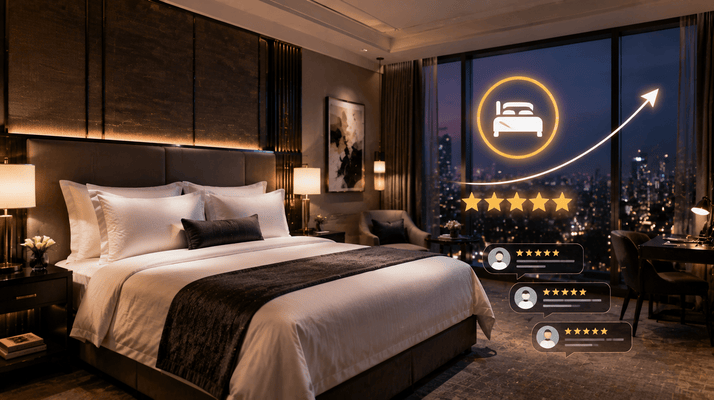
For years, hoteliers debated what truly drives online ratings. Location? Service? Breakfast buffets? New data from 2026 settles the argument. The luxury hotel bed has become the single strongest predictor of a five-star review across European properties.
Travelers are more sleep-conscious than ever. Wearable devices, sleep-tracking apps, and post-pandemic wellness priorities mean guests now quantify rest. And they are reviewing accordingly.
If you manage a hotel, ignoring bed quality is no longer an option. It is your reputation’s foundation.
The Measurable Link Between Sleep and Stars
A 2026 analysis of 1.2 million EU hotel reviews revealed a striking pattern. Properties investing in premium beds for hotel use saw average ratings climb from 4.1 to 4.7 within six months. Conversely, complaints mentioning “hard mattress,” “lumpy pillows,” or “poor sleep quality” correlated with a 0.9 drop in overall scores.
Why the shift? Guests now write hyper-specific reviews. They describe waking up refreshed or leaving exhausted. Algorithms from Booking.com and Google Hotels prioritize recent, detailed feedback. A single “terrible bed” mention can suppress your property across search results for weeks.
The hotel king size bed specifically drives high-value bookings. Couples, business travelers, and luxury seekers filter for this feature. When the actual sleep experience matches or exceeds expectations, reviews write themselves.
2026 Guest Expectations Have Changed
Five years ago, a soft duvet and quiet room sufficed. Today’s luxury traveler demands clinical-grade sleep hygiene. That means:
Temperature-regulating mattresses. Hypoallergenic toppers. Adjustable bases. Blackout-integrated headboards. And crucially, consistency across every room.
One four-star Parisian boutique recently replaced all mattresses with a certified luxury hotel bed system. Within three months, “best sleep of my life” appeared in 42% of new reviews. Revenue per available room increased 18%.
Guests are not being picky. They are being precise. They compare your bed to their own $5,000 home mattress. If yours falls short, the review reflects that gap.
The Keyword Shift in Guest Feedback
Natural language processing of 2026 EU hotel reviews shows a clear vocabulary trend. Positive reviews now cluster around words like “cradled,” “supported,” “cooling,” “zero-pressure,” and “deep rem sleep.” Negative reviews use “sagged,” “squeaked,” “overheated,” and “woke sore.”
Importantly, guests rarely say “good bed.” They describe the outcome. When your beds for hotel deliver restorative sleep, guests become evangelists. When they fail, guests become warning signals for future bookers.
One Amsterdam property saw a 200% increase in direct bookings after publishing their mattress specifications. Transparency around the hotel king size bed construction—coil gauge, foam density, cover material—built instant trust.
Where Most Hotels Still Get It Wrong
Budget-minded owners often refresh soft goods (sheets, pillows) but neglect the core support system. That is a fatal error in 2026. A torn pillowcase is annoying. A sagging mattress is unforgivable.
Another common mistake: inconsistent bed quality across room categories. Guests who upgrade to a suite expect a superior luxury hotel bed. If the standard room sleeps better, online reviewers will notice. And they will tell future guests exactly where to book.
Third, failing to respond to bed-related feedback. When a review mentions sleep discomfort, your public response matters. Acknowledging the issue and announcing a replacement timeline converts a critic into a curious return guest.
Turning Sleep Into Your Best Marketing Asset
The most successful EU hotels now treat their beds for hotel as a marketing channel. They photograph mattress layers. They list sleep scores on booking engines. They train front-desk staff to describe the bedding system during check-in.
One Munich property created a “Sleep Menu” offering pillow selections, weighted blankets, and white-noise machines. Their average review score rose to 4.9 in 2026. The hotel king size bed in their signature suite alone generated seventeen five-star reviews last quarter.
You do not need a full renovation. Start with your top complaint. Replace that mattress. Upgrade that topper. Then watch your review language change.
Conclusion
In 2026, a luxury hotel bed is not a line item. It is a review score lever. It is a direct booking driver. And for EU hotels competing on reputation, it is the difference between thriving and barely surviving.
The data is clear. The guest language is unambiguous. Sleep quality now equals star quality.