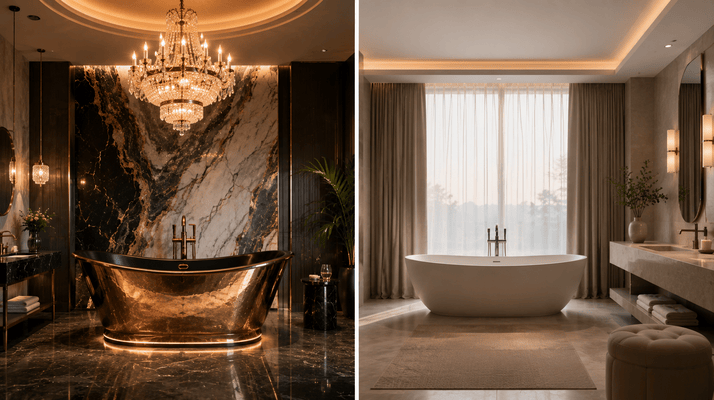
The hotel bathroom has escaped its cramped closet. No longer a afterthought behind a closed door, it now competes for attention with the bedroom itself. And at the center of this transformation sits the tub. But here is the question every hotel owner faces: should your hotel bathtubs roar or whisper?
I asked three acclaimed hospitality designers to settle the debate. Their answers depend entirely on room size, guest expectations, and the emotional story you want to tell. A luxury bathtub placed incorrectly frustrates. Placed with intention, it becomes the reason guests book again.
The Hero: When the Tub Commands the Room
Designer Clara Mei insists that a statement tub belongs only in spaces with volume. “A luxury modern bathtub needs breathing room,” she told me. “If a guest can touch the tub and the wall at the same time, hide it. The hero demands distance.”
In suites with floor‑to‑ceiling windows, Mei places the tub front and center. Often on a raised platform. Sometimes directly facing the view. “The guest wants to soak while watching the city or the sea. That experience sells itself. I have seen properties charge $400 more per night for the same square footage simply by repositioning the hotel bathtubs toward the window.”
Materials matter for a hero tub. Freestanding luxury bathtub designs in cast stone, copper, or hand‑hammered metal announce themselves immediately. White acrylic blends in. Matte black or terrazzo stands out. Mei also adds a dramatic floor‑mounted filler rather than a wall spout. “The arc of water becomes part of the performance.”
She warns against one mistake: placing a hero tub where housekeeping must crawl around it. “If your staff cannot clean efficiently, the hero becomes a villain.”
The Supporting Actor: When Subtlety Wins
Other rooms demand restraint. Designer Henrik Voss handles mostly standard suites and connecting rooms. “In tight spaces, a luxury modern bathtub that screams for attention makes the whole room feel smaller,” he explained. “Here, the tub should be a supporting actor. Comfortable. Well‑lit. But visually quiet.”
His preferred solution is a built‑in or alcove tub with a tile front that matches the bathroom walls. The tub recedes. The guest notices the spaciousness, the water pressure, the heated floor—not the fixture itself. “A supporting hotel bathtub gets praised in reviews as ‘the perfect soak.’ A poorly executed hero tub gets mocked as ‘that weird thing in the middle of the room.’”
Voss uses freestanding tubs in smaller spaces only when they are narrow and wall‑hugging. Japanese soaking tubs, deep but compact, work well. Their small footprint keeps the room open. “Guests remember how the water felt, not how the tub looked. That is the supporting actor’s victory.”
The View Test: A Simple Decision Tool
Designer Elena Wu offered a practical rule she calls the View Test. “Stand at the bathroom entrance. Where does your eye go first? If a window with a stunning view exists, do not block it with a luxury bathtub. Place the tub perpendicular to the glass so the guest looks past the faucet toward the outside.”
If the bathroom has no view—interior room, windowless, or facing a wall—Wu makes the tub the view. “That is when you bring in a luxury modern bathtub with sculptural lines. The tub becomes art. The guest stares at the curves instead of the blank wall.”
She showed me before‑and‑after photos of a Manhattan hotel. Original layout: windowless bathroom with a basic alcove tub. Guest complaints about feeling claustrophobic. Wu installed a glossy black freestanding oval tub with a polished chrome floor mount. Complaint rate dropped to zero. Review photos now feature the tub prominently.
Material Clues for Hero vs Supporting
The material of your hotel bathtubs sends a clear message. Hero tubs use stone resin, hammered copper, or volcanic limestone. These materials feel substantial and photograph beautifully. Supporting tubs use high‑gloss acrylic or solid surface. They are warm to the touch, easy to clean, and visually discreet.
Color follows the same logic. A hero luxury bathtub can be matte black, blush pink, or deep green. A supporting tub should be white or off‑white. “Never make a supporting actor fight for attention with color,” Wu said. “That just creates visual noise.”
The Verdict from Designers
All three designers agreed on one final point: consistency matters more than individual heroics. A suite with a statement tub should have a matching statement shower. A supporting tub belongs in a bathroom where every element—vanity, lighting, tile—works as an ensemble.
“The worst hotels mix philosophies,” Mei concluded. “A hero tub next to a cheap plastic shower curtain. Or a beautiful supporting tub with a chandelier screaming above it. Pick a role. Cast every element accordingly.”
Final Soak
Your hotel bathtubs tell guests how to feel. A hero tub says, “Indulge. Stay awhile. Photograph me.” A supporting tub whispers, “Rest here. I will not distract you.” Neither approach is wrong. But mixing them confuses the story you are trying to sell. Choose your lead actor. Let the rest of the bathroom follow its cue.